
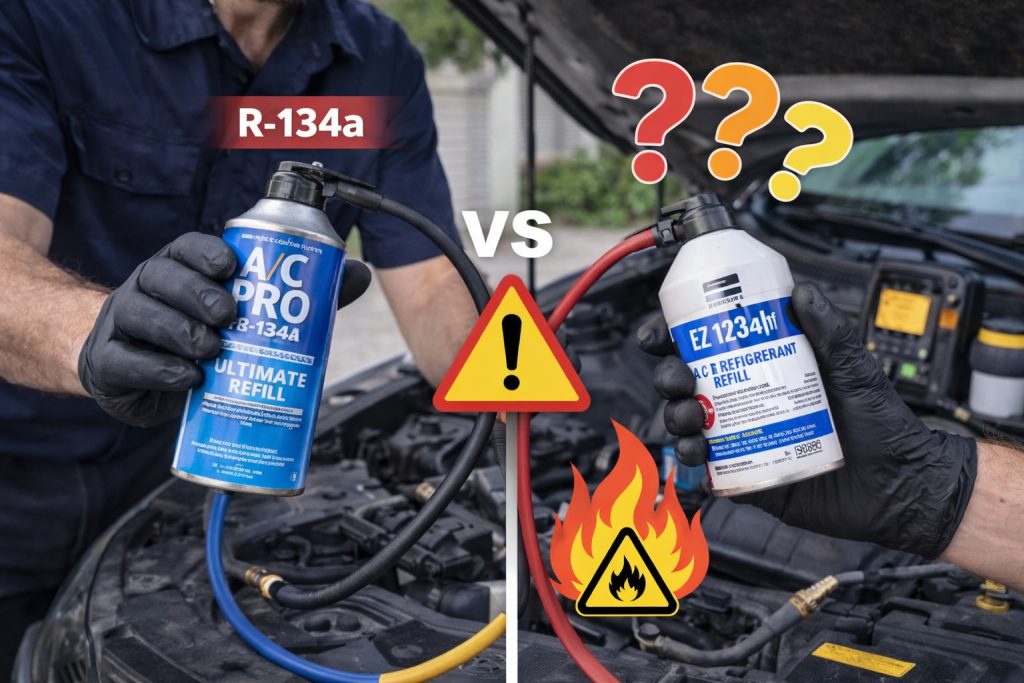
It Looks Like the Same Job — But It Isn't
If your car’s A/C starts blowing warmer, the most common thought is: “It’s probably low—let me add a little.”
That logic became popular in the R-134a era because DIY kits were everywhere. But with modern vehicles using R-1234yf, the “quick top-off” approach becomes riskier, more expensive, and less forgiving.
Here’s the simple truth:
R-1234yf systems are still A/C systems—closed, sensitive to exact charge, and dependent on a clean, dry environment. But the cost of guessing is much higher.
The First Big Difference: R-1234yf Costs More
This is the part people feel immediately: R-1234yf recharge costs more than R-134a.
That matters because “trial-and-error” gets expensive fast. If you add refrigerant to a system that has a leak—or you add the wrong amount—you’re not just risking performance. You’re risking money.
So before anyone adds refrigerant, the key question should be:
Is the system tight, and are we charging by weight?
Because “topping off” without those two things is basically paying for uncertainty.
Pressure Guessing Is the Same Old Trap — Just More Expensive
A common DIY approach uses a simple gauge and the idea that pressure tells you what to do.
But pressure does not equal charge amount. Pressure changes with:
- outside temperature,
- engine RPM,
- airflow across the condenser,
- and system load.
Simple analogy:
Dashboard temperature ≠ how much coolant is in the engine.
A reading can look “normal” while the amount is wrong. A/C works the same way: pressure is a behavior signal, not a measured refrigerant quantity.
So if you’re trying to decide how much R-1234yf does my car need by looking at a gauge, you’re guessing.
And with R-1234yf, guessing is pricey.
Overcharge Risk: "Just a Little More" Can Push You Past the Line
Another reason R-1234yf is riskier to “top off” is that the charging process is often treated casually—when it shouldn’t be.
A/C systems are designed around an exact target charge by weight. When you don’t control that, you can end up undercharged or overcharged.
Overcharge can lead to:
- unstable cooling,
- inefficient operation,
- increased system stress,
- and potential compressor risk.
And here’s the annoying part: undercharge and overcharge can feel similar from the driver’s seat—”it’s not cold enough.”
That’s how people get stuck in a loop:
- it’s a little warm
- add a little
- it improves
- it fades again
- add more
- now it behaves worse than before
Then the complaint becomes: car A/C not cold R-1234yf or even car A/C stopped working after recharge.
The Real Issue: If It's Low, There's Usually a Leak
This is the most important concept to understand:
An automotive A/C system is a closed system. Refrigerant doesn’t “get used up.” If it’s low, it usually means it leaked.
So a “top off” often ignores the real problem:
- the leak is still there,
- the refrigerant will leave again,
- and you’ll be back in the same place—only poorer.
That’s why recharge by weight and leak verification matter so much, especially when the refrigerant is expensive.
Fully Empty or Very Low? That's Not a "Top-Off Situation"
If the system is empty or close to empty, adding refrigerant without confirming tightness is the fastest way to burn money.
In that case the correct approach is:
- confirm the system condition,
- use vacuum evacuation to remove air and moisture,
- and if vacuum doesn’t hold, move to pressure-based leak verification (commonly with dry nitrogen) before charging
If your A/C is near-empty, the right question isn’t “how do I top it off?”
The right question is: “why is it empty, and is it sealed?”
Another DIY Risk: Unknown History and Unknown Mixes
With used vehicles—or vehicles that have been serviced before—you may not know:
- what was added previously,
- whether additives were introduced,
- whether the service was done correctly.
R-1234yf systems are not a great place for uncertainty. The safest path is restoring control:
- recover/evacuate properly,
- keep the system clean and dry,
- and charge by weight to specification.
The goal is not “make it colder today.” The goal is stable performance that lasts.
The Good News: The Correct Method Is Straightforward
The correct approach to R-1234yf recharge isn’t mysterious. It’s just controlled:
- Confirm symptoms and system condition
- Recover what’s in the system (if anything remains)
- Vacuum evacuate to remove air and moisture
- Verify tightness when needed (especially if the system was low/empty)
- Charge by weight to the manufacturer specification
- Confirm stable performance
That’s what turns a high-cost refrigerant into a reliable result instead of a gamble.
How ACRechargePro Handles R-1234yf Correctly
ACRechargePro focuses on a clean, measurable process:
- Certified refrigerants only
- EPA Section 609–licensed service
- Recovery + vacuum evacuation (remove air/moisture)
- Recharge by weight to the correct specification
- Leak verification and nitrogen pressure testing when appropriate
- Mobile service: we come to your driveway
- Typical service time: 60–90 minutes
- No guessing. No waste. Controlled results.
We’re not here to attack DIY. Wanting to save money is normal. But with R-1234yf, the “cheap shortcut” often becomes the expensive route.
Conclusion
R-1234yf vs R-134a isn’t just a label difference. The big difference is the cost of mistakes.
A DIY “top off” relies on pressure guessing, doesn’t confirm leaks, and doesn’t ensure the correct charge by weight—so it’s easy to waste refrigerant and end up with unstable cooling or worse.
If you want it done once—and done correctly—use vacuum evacuation and recharge by weight, with leak verification when needed.
Schedule professional A/C service now:
Related Articles
Frequently Asked Questions
Is R-1234yf really that different from R-134a?
The system principles are similar, but the cost of mistakes is higher. That's why controlled service matters more.
Can I top off R-1234yf with a DIY kit?
You can attempt it, but it's risky because pressure doesn't confirm the correct charge amount, and leaks remain unverified.
How do I know how much R-1234yf my car needs?
The correct amount is manufacturer-specified by weight. The correct method is charging by weight after proper evacuation.
Why does my R-1234yf A/C cool sometimes but not consistently?
Common causes include low charge from a leak, an incorrect charge amount, or an underlying system issue that wasn't addressed.
If my A/C was empty, should I recharge it immediately?
No. If the system was empty or near-empty, leak verification should happen before charging to avoid wasting refrigerant.
Why is vacuum evacuation important?
Vacuum removes air and moisture. Moisture can lead to corrosion and long-term reliability problems.
How long does professional R-1234yf service take?
Typically 60–90 minutes, depending on system condition and whether leak verification is needed.