
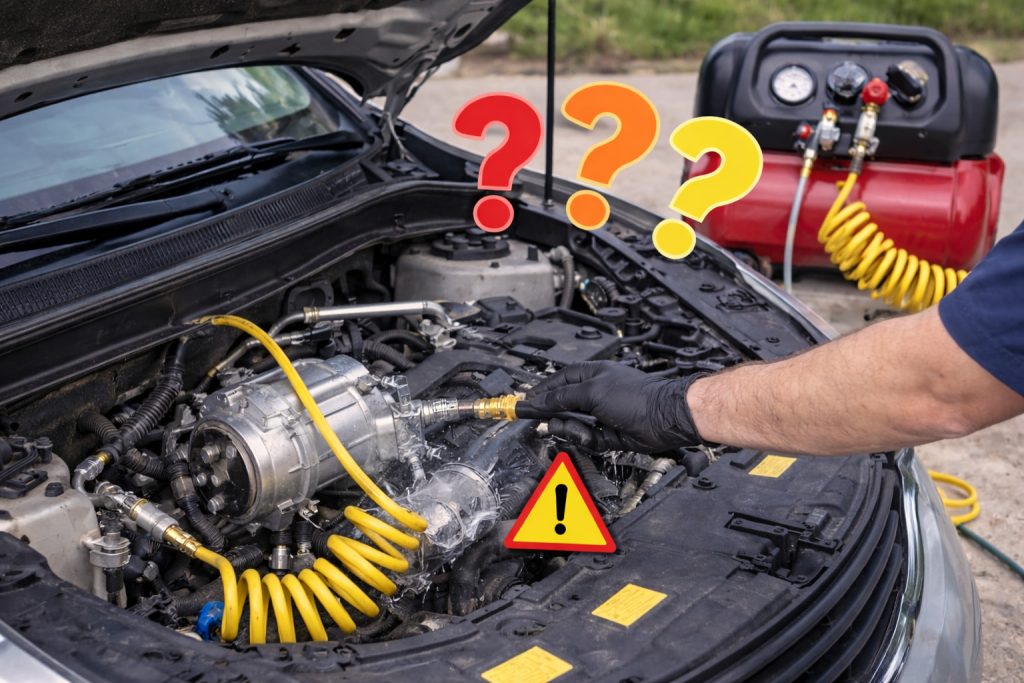
The "Air Compressor Test" Sounds Convenient — But It's the Wrong Tool
- But an automotive A/C system isn't just "any sealed container." It's designed to stay clean and dry inside.
Introducing the wrong gas can create problems that don’t show up immediately—then later turn into performance issues, corrosion, or costly repeat failures.
The short version: compressed air is not a clean test medium for A/C systems. The correct approach is dry nitrogen, using a controlled, professional leak verification process.
Key Problem #1 — Compressed Air Brings Moisture
Even if your compressor has a water trap, compressed air almost always carries moisture. That moisture can enter the A/C system during pressurization.
Why that matters:
- Moisture can contribute to internal corrosion over time.
- Moisture can lead to unstable performance.
- Moisture complicates future service and can make a “simple leak” become a long-term reliability issue.
- That's why the correct A/C service procedure includes vacuum evacuation—to remove air and moisture before charging. If you add moisture back in with a compressor test, you're undoing a major part of doing it right.
This is the core reason compressed air pressure testing is a bad habit in A/C work.
Key Problem #2 — Air Contains Oxygen
Compressed air isn’t an inert gas. It contains oxygen, and oxygen isn’t something you want circulating inside a system designed around refrigerant and oil.
Oxygen can accelerate oxidation and corrosion, especially when combined with moisture. You may not “see” the damage immediately, but it can show up later as:
- reduced system reliability,
- component degradation,
- repeat contamination symptoms.
- This is one reason professionals prefer dry nitrogen pressure testing: nitrogen is inert and dry, so it doesn't add reactive chemistry or water to the system.
Key Problem #3 — Air Doesn't Match the Best Practice for Leak Verification
A/C leak verification should be:
- controlled,
- stable,
- repeatable,
- and clean.
Compressed air often isn’t.
- It can vary in dryness.
- It can carry compressor oil mist or contaminants.
- The result can look “fine today,” then fail later.
A professional A/C leak check is about confirming tightness before charging. That’s especially important because charging is expensive—and if the system isn’t tight, you’re paying to leak refrigerant back out.
Key Problem #4 — "It Held Pressure" Can Be a False Sense of Security
Even when using the correct gas, the test has to be done correctly. With compressed air, there’s an extra issue: it can create “pass/fail” assumptions without real control of moisture and contamination.
The result can be the worst outcome for a customer:
- it “seemed okay,” you recharge, cooling fades, and now the customer says: car A/C stopped working after recharge.
Leak verification is supposed to prevent that scenario—not set it up.
So What Should You Use Instead? Dry Nitrogen
If your goal is to confirm leak integrity without contaminating the system, the standard answer is dry nitrogen.
Why nitrogen:
- It's inert
- It's dry
- Provides stable pressure for monitoring
- No moisture or oxygen-driven corrosion risk
In other words: dry nitrogen pressure testing gives you a clean way to confirm whether the system is tight before refrigerant goes back in.
This is especially important when:
- the system was empty or very low,
- vacuum doesn't hold,
- the vehicle has unknown prior service history,
- you suspect a leak but it's not visible.
The Right Sequence When a System Won't Hold Vacuum
A common mistake is trying to “force the recharge anyway.” That’s how you get unstable cooling and repeat visits.
A clean, professional flow looks like this:
- Confirm the system condition (empty/low, prior repairs, symptom history).
- Attempt vacuum evacuation to remove air/moisture.
- If vacuum does not hold, don't charge refrigerant.
- Move to nitrogen pressure testing for leaks to verify tightness and locate the leak path.
- Repair the leak, then return to vacuum evacuation and recharge-by-weight.
- This prevents the loop of "recharge → leaks out → recharge again."
What About "Just a Quick Test" With Air?
If you’re trying to make a fast decision, air might look like a shortcut. But in A/C work, shortcuts often become expensive.
A/C reliability is built on:
Dryness
Cleanliness
Tight Sealing
Accurate Weight
Compressed air undermines at least two of those pillars (dryness and cleanliness). That’s why the “quick test” can create a long-term headache.
How ACRechargePro Approaches Leak Verification
ACRechargePro uses a controlled process designed to protect the system and avoid repeat failures:
- Certified refrigerants only
- EPA Section 609–licensed service
- Recovery + vacuum evacuation
- Recharge by weight to specification
- dry nitrogen pressure testing when appropriate to confirm leak integrity
- Mobile service at your location (driveway service)
- Typical service time: 60–90 minutes (depending on condition and testing needs)
- No guessing. No "hope it holds." A measurable process that protects your system.
Conclusion
Using an air compressor to pressurize an A/C system seems convenient, but it can introduce moisture and oxygen—two things an A/C system does not want inside. That’s why compressed air pressure testing can backfire and contribute to long-term problems.
If you want a clean confirmation before recharging, dry nitrogen pressure testing is the correct method—especially when vacuum doesn’t hold.
Schedule professional A/C service now:
Related Articles
Frequently Asked Questions
Can I use compressed air to find an A/C leak?
You can pressurize with air, but it’s not recommended because it can introduce moisture and contaminants into the system.
Why is moisture such a problem in A/C systems?
Moisture can contribute to corrosion and long-term reliability issues and can make performance inconsistent.
What's the best gas to pressure test an A/C system?
Dry nitrogen is preferred because it’s inert and dry, and it supports stable leak verification.
If my system won't hold vacuum, should I recharge anyway?
No. If vacuum doesn’t hold, you should confirm leaks first (often with nitrogen pressure testing) before adding refrigerant.
Can a system pass vacuum and still leak?
In borderline cases, yes. That’s why pressure-based verification can be appropriate when there’s doubt.
Why did my car A/C stop working after recharge?
Common causes include an incorrect charge amount, a leak that wasn’t confirmed, or air/moisture issues that weren’t addressed before charging.
How long does proper A/C service take?
Typical service time is 60–90 minutes, depending on system condition and whether leak verification is needed.