
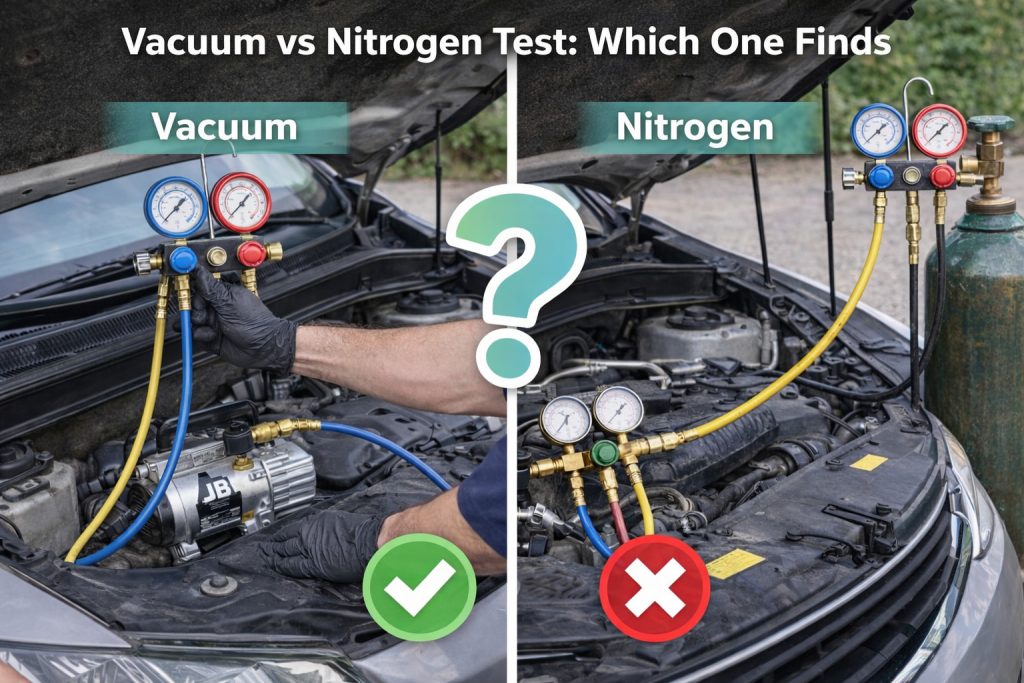
The Confusion Is Understandable
When your car A/C isn’t blowing cold, you’ll hear a lot of advice that sounds confident but doesn’t always explain the why. Two of the most common phrases are:
- "We pulled vacuum—so it's fine."
- "We pressure tested it—so it's leak-free."
Both procedures are real. Both are useful. But they answer different questions.
If you want A/C service done correctly (and you want to avoid repeat failures), it helps to understand a simple truth:
- Vacuum and nitrogen testing are not competitors. They're different tools for different purposes.
Think of it like this:
A vacuum test is like drying and clearing the system before refilling it.
A nitrogen test is like confirming the system is actually sealed before you spend money on refrigerant.
What Vacuum Evacuation Is Really For
Vacuum evacuation is a core step in correct A/C service. The purpose is:
Remove air
Remove moisture
Charge by weight
This matters because A/C systems are designed to be clean and dry internally. Moisture and air reduce performance and can contribute to long-term reliability problems.
- So vacuum evacuation is not a "nice-to-have." It's a required part of doing things right—especially after the system has been opened or when it has been empty.
That’s why professional service includes vacuum evacuation as a standard step before recharge.
What a Vacuum Test Can Tell You
A vacuum test is often used as a quick check of sealing integrity: if the system can pull vacuum and hold it, that’s a good sign.
It can help you catch:
- obvious leaks,
- major sealing issues,
- installation errors after repairs.
In many cases, if a system won’t hold vacuum, that’s a strong indicator of a leak or open path—meaning you should not recharge.
- If your A/C system won't hold vacuum, that's a clear "stop and verify" moment.
What a Vacuum Test Cannot Guarantee
Here's the part that surprises people:
A system can sometimes hold vacuum yet still leak under pressure.
Why? Because vacuum and pressure stress the system differently. Certain leak paths can behave differently depending on conditions. That’s not a theory—it’s why pressure-based verification exists in professional workflows.
So while a vacuum hold is a good sign, it is not always a bulletproof guarantee of “no leaks.”
That’s why “vacuum-only” confirmation can sometimes lead to the most frustrating outcome:
Refrigerant added
Cooling works briefly
Performance fades
People often describe that as: car A/C stopped working after recharge.
What Nitrogen Pressure Testing Is For
A nitrogen pressure test is used to confirm sealing integrity under pressure conditions—without contaminating the system.
Dry nitrogen is preferred because it’s:
- ✓ Inert
- ✓ Dry
- ✓ Stable for monitoring
In practical terms, dry nitrogen pressure testing is a clean way to answer one key question:
"Is the system actually tight before we recharge?"
This is especially important when:
- the system was empty or near-empty,
- the leak isn't obvious,
- prior service history is unknown,
- vacuum doesn't hold,
- you want to avoid spending refrigerant on a system that isn't sealed.
Nitrogen testing is not about drama. It’s about certainty.
Vacuum vs Nitrogen: A Simple Side-by-Side
Vacuum Evacuation Answers:
- "Did we remove air and moisture?"
- "Is the system prepared for a correct recharge by weight?"
- "Is there an obvious sealing failure that prevents holding vacuum?"
Nitrogen Pressure Testing Answers:
- "Is the system tight under pressure?"
- "Can we confidently recharge without guessing?"
- "Do we need to find and fix a leak before adding refrigerant?"
They complement each other. A correct workflow often uses both—each in the right place.
The Most Common Real-World Scenario
Here’s a clean, professional decision flow:
- Recover remaining refrigerant (if any)
- List Item Perform vacuum evacuation to remove air and moisture#1
- If the system won't hold vacuum, stop
- Perform nitrogen pressure testing for leaks
- Repair the leak
- Vacuum evacuate again
- Recharge by weight to specification
- This prevents the "recharge and hope" cycle.
Why "Vacuum-Only" Service Is Often a Problem
Some fast services rely heavily on vacuum as a pass/fail check—because it’s quick and easy to run.
The downside is that vacuum-only checks can:
Miss borderline leak behavior
Give false sense of security
Lead to recharges on unsealed systems
That’s one reason automatic-style service workflows that do “vacuum + recharge” without deeper verification can look efficient, yet still produce repeat problems.
Efficiency is great—but only when it’s paired with control and confirmation.
What This Means for You as a Customer
If your A/C is weak or inconsistent, the best question isn’t “can you add refrigerant?”
The best questions are:
- "Are you recharging by weight to the manufacturer spec?"
- "Do you do leak verification before charging if there's doubt?"
- "If the system won't hold vacuum, what happens next?"
Those questions tell you whether you’re buying a controlled process—or guesswork.
How ACRechargePro Uses Both
ACRechargePro focuses on repeatable, measurable service:
- Certified refrigerants only
- EPA Section 609–licensed process
- Recovery + vacuum evacuation
- Recharge by weight (not by gauge guessing)
- nitrogen pressure testing for leaks when appropriate to confirm tightness before charging
- Mobile service at your location (driveway service)
- Typical service time: 60–90 minutes
No guessing. No “green zone” logic. A clean process built to avoid repeat failures.
Conclusion
Vacuum evacuation and nitrogen pressure testing aren’t the same thing — and they’re not interchangeable.
- Vacuum evacuation removes air and moisture and prepares the system for a correct charge by weight.
- A nitrogen pressure test confirms sealing integrity under pressure before you invest in refrigerant.
If you want to do it once—and do it correctly—use the right tool at the right time.
Schedule professional A/C service now:
Related Articles
Frequently Asked Questions
Is vacuum evacuation the same as a leak test?
No. Vacuum evacuation removes air and moisture. A vacuum hold can suggest sealing, but it doesn't always guarantee leak-free performance under pressure.
If my A/C system won't hold vacuum, what does that mean?
It usually indicates a leak or an open path. In that case, you should not recharge—leak verification should come next.
Why use nitrogen instead of compressed air?
Dry nitrogen is inert and dry. Compressed air can introduce moisture and oxygen, which isn’t ideal for A/C system cleanliness and reliability.
Can a system hold vacuum and still leak?
In some borderline cases, yes. That’s why pressure-based verification is valuable when there’s uncertainty.
Do I always need nitrogen testing?
Not always. It’s most useful when the system was empty/very low, vacuum doesn’t hold, the leak source isn’t clear, or you want stronger confirmation before recharging.
Why did my car A/C stop working after recharge?
Common causes include recharging without confirming tightness, incorrect charge amount (not by weight), or air/moisture issues that weren’t handled correctly.
How long does proper service take?
Typically 60–90 minutes, depending on system condition and whether additional leak verification is needed.