
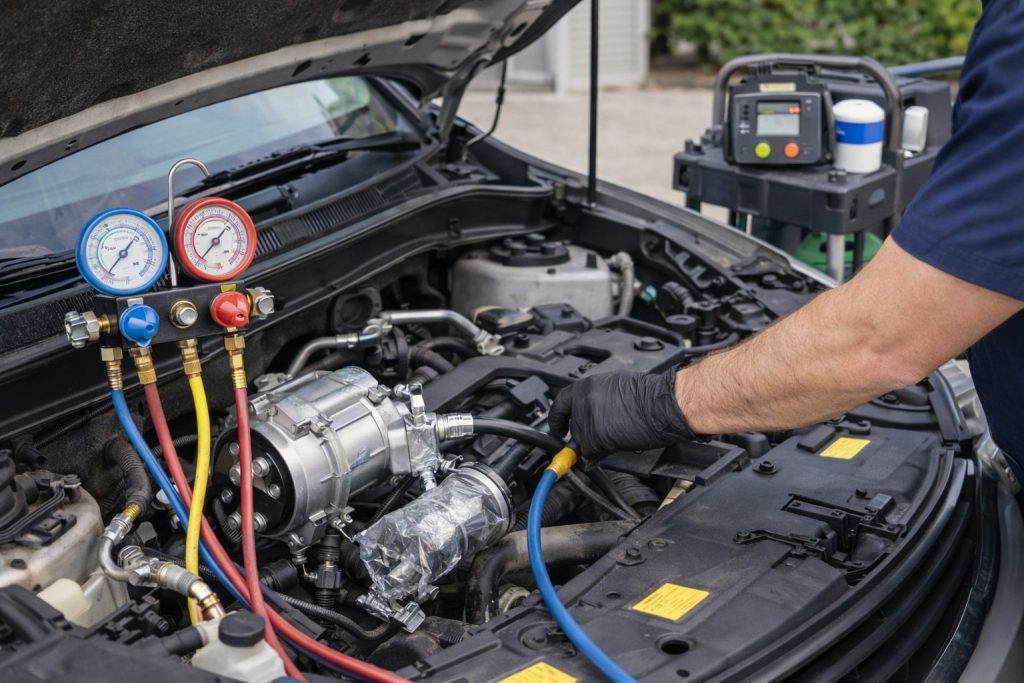
Why "Just Recharge It" After Repairs Often Backfires
When an A/C component is replaced—like a condenser, compressor, hose, or an accumulator/receiver-drier—many people assume the next step is simple: “Put refrigerant back in and we’re done.”
But once a system has been opened, it's no longer just about refrigerant. It's about:
- removing air and moisture,
- restoring the correct charge by weight,
- making sure the system is tight before it's put back into normal operation,
- and avoiding the most expensive outcome: a repeat failure that turns a repair into a bigger repair.
Think of it like changing a key engine part and then guessing the oil quantity afterward. The part may be new, but the final result depends on doing the fill correctly.
- The good news is: the correct recharge process isn't complicated—it's just structured, measurable, and clean.
Step 1 — Confirm What Was Replaced and Why
Before refrigerant goes in, the first question should be: what problem are we solving?
A/C parts are replaced for different reasons:
Leak repair
Compressor failure
Collision damage
Restriction/contamination
Weak performance caused by internal wear
The reason matters because it determines the risk level. A system that was opened for a simple leak repair is very different from a system that had a compressor failure.
- If a compressor failed, there may be contamination in the system. If a hose was replaced for a known leak, the system might be otherwise clean.
The recharge procedure should match the reality—not assumptions.
Step 2 — Don't Guess the Refrigerant Amount (Charge by Weight)
Every vehicle has a manufacturer-specified charge amount, listed by weight (ounces or grams). It’s not “about this much.” It’s exact for a reason.
Why this matters after parts replacement:
- The system's performance depends on being in the correct charge range.
- "Pressure looks okay" is not a reliable indicator of correct charge.
- Temperature, airflow, and load conditions can make pressure readings misleading.
- That's why the correct approach is: recharge by weight—not by gauge color and not by "it feels cold enough."
If you’re trying to decide how much refrigerant your car needs based on pressure alone, you’re guessing.
Step 3 — Recovery and Vacuum Evacuation: Remove Air and Moisture
Once an A/C system has been opened, air and moisture can enter. That matters because A/C systems are designed to be clean and dry internally.
This is where vacuum evacuation is essential:
Removes air that reduces efficiency
Removes moisture that can lead to corrosion
Stabilizes the environment inside the system
- Vacuum evacuation isn't an "extra step." It's a core requirement for a correct, repeatable result.
Step 4 — Leak Verification Before Charging
Here’s a common scenario:
A part is replaced, the system is vacuumed, and the vacuum “holds”—so someone assumes the system is leak-free and charges refrigerant.
The problem is that vacuum is not the same as real-world pressure conditions. In borderline cases, a system can appear to hold vacuum but still leak under pressure.
- That's why, when there's any doubt, the correct next step is leak verification under pressure (for example, using dry nitrogen). It's a clean way to confirm whether the system is tight before expensive refrigerant is added.
This is especially important when:
- the system was empty or very low,
- multiple components were replaced,
- the leak source wasn't visually obvious,
- or the vehicle has a history of repeated low charge.
Charging without confirming tightness is one of the fastest paths to repeated failures.
Step 5 — Oil Management Matters
Another mistake after repairs is treating compressor oil like “more is safer.”
A/C systems are designed for a specific total oil amount. Too little can be harmful, but too much can also cause problems—reduced efficiency, unstable performance, and avoidable headaches later.
- After component replacement, oil amount may need adjustment depending on what was replaced and how much oil was lost. The correct approach is controlled and intentional—not random "add a little oil every time."
This also matters because many retail recharge products include oil or dye mixed into the can, and repeated use can slowly create too much A/C oil—especially after repairs, when people are more likely to “top off just in case.”
Step 6 — Final Performance Check
After a correct recharge, the job isn’t “done” until the system performs consistently.
A professional verification includes:
Stable cooling performance
Predictable behavior at idle and while driving
No obvious signs of instability
A result that doesn't depend on "today's weather"
- If the A/C seems cold for five minutes but fades, cycles strangely, or becomes inconsistent, that's a sign something is still off—charge amount, airflow, sealing, or an underlying issue.
The Good News: A Correct Recharge Is Repeatable
When done properly, A/C service is not guesswork. It’s a controlled process.
The core principles are simple
- Recover properly
- Evacuate with vacuum to remove air and moisture
- Confirm sealing integrity (and verify under pressure when needed)
- Recharge by weight to the manufacturer spec
- Verify stable performance
- This prevents the most common DIY failure pattern: "it seemed fixed, then got worse."
How ACRechargePro Does It Correctly
ACRechargePro follows a clean, measurable process designed to avoid repeat failures:
- Certified refrigerants only
- EPA Section 609–licensed service
- Recovery + vacuum evacuation
- Recharge by weight to the correct specification
- Leak verification and nitrogen pressure testing when appropriate
- Mobile service: we come to your driveway (no shop visit needed)
- Typical service time: 60–90 minutes
- No guessing. No risk stacking. Just a controlled result.
We’re not here to criticize DIY. Saving money makes sense. But after parts replacement, doing it “almost right” is often what creates the expensive second repair.
Conclusion
After replacing A/C components, a correct recharge is not “just add refrigerant.” It’s a process: remove air and moisture, confirm sealing, and charge by weight to spec.
- That's how you avoid improper A/C recharge consequences—unstable cooling, repeat leaks, and cases where car A/C stopped working after recharge.
Schedule professional A/C service now:
Related Articles
Frequently Asked Questions
Do I need a vacuum after replacing A/C parts?
Yes. Vacuum evacuation removes air and moisture that can cause poor performance and long-term reliability problems.
Can I just recharge after replacing a condenser or hose?
Not safely. The correct procedure includes recovery (if any refrigerant remains), vacuum evacuation, and recharging by weight to specification.
How do I know how much refrigerant my car needs?
The exact amount is specified by the manufacturer by weight. Professional service charges by weight, not by pressure guessing.
If the vacuum holds, does that mean there are no leaks?
Not always. Vacuum is useful, but in uncertain cases, verifying tightness under pressure is a cleaner confirmation before charging.
Why does oil matter after A/C repairs?
Because the system is designed for a specific oil amount. Too little or too much can cause performance issues and long-term problems.
What if my car A/C stopped working after recharge?
Often it’s an incorrect charge amount, air/moisture issues, a leak that wasn’t confirmed, or an underlying mechanical problem that wasn’t addressed.
How long does professional A/C service take?
Typical service time is 60–90 minutes, depending on the condition of the system and whether leak verification is needed.