
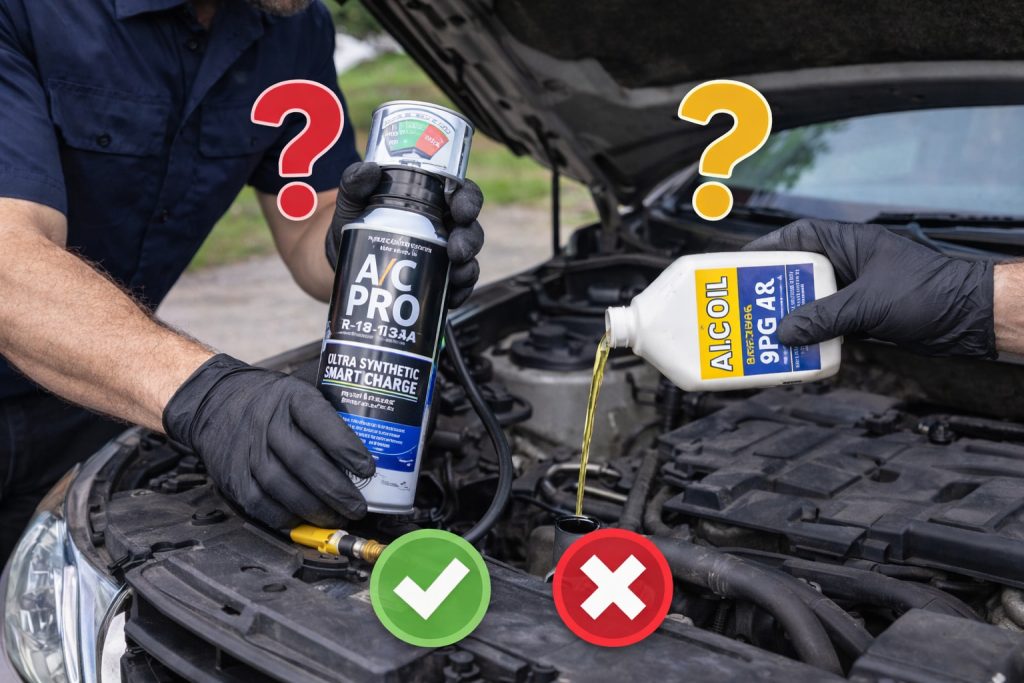
More Oil Must Be Better,” Right? Not in an A/C System
When your car A/C isn’t blowing cold, a lot of DIY advice pushes the same idea: “Add refrigerant—and add a little oil while you’re at it to protect the compressor.”
It sounds reasonable, because in many systems oil is a “good thing.” But an automotive A/C system doesn’t work like an engine. It’s a closed loop designed for a specific total oil quantity. Oil isn’t something you should keep adding “just to be safe.”
Simple analogy:
Adding oil during an A/C recharge isn’t like adding washer fluid. It’s closer to adding engine oil without checking the dipstick—do it repeatedly and you can create a bigger problem than the one you started with.
The goal isn’t “more.” The goal is the correct amount.
Why Oil Even Matters in the First Place
A/C oil is used to lubricate internal compressor components and to move through the system in the way the system is designed to operate. Without the correct oil level, you can have:
- poor lubrication and increased wear, or
- reduced performance if the system is overloaded with oil.
So yes—oil matters. But that’s exactly why guessing is risky.
The Big Problem: You Don't Know How Much Oil Is Already Inside
Most drivers do not know:
- the system’s current oil amount,
- what was added during past service,
- or whether a previous recharge product already included oil.
That uncertainty is why A/C oil in recharge cans is one of the most common ways people accidentally create too much A/C oil over time.
And oil accumulation doesn’t always “announce itself” immediately. It often shows up as:
- weaker cooling than expected,
- inconsistent performance,
- or a system that becomes harder to diagnose later.
"But My Can Says It Helps the Compressor" — Here's the Catch
Many retail recharge products and DIY kits include extras such as:
- oil,
- dye,
- sealants,
- or blends/substitutes.
Even if the label makes it sound helpful, the problem is control:
- You don’t know the exact baseline oil amount in your system.
- You don’t know how much oil is being added with each use.
- Repeated “small adds” stack up.
This is why A/C oil in recharge cans can become a silent long-term problem—especially when drivers top off multiple times across seasons.
What Can Too Much Oil Actually Do?
This is where people get surprised. Excess oil can create real consequences, including:
1) Lower cooling efficiency
Heat exchange depends on proper flow and balance. Too much oil can reduce efficiency and leave you thinking the charge is wrong—even when refrigerant is close.
2) Unstable performance ("cold sometimes, weak sometimes")
Oil can pool or migrate unpredictably, which can contribute to inconsistent behavior that looks like a mysterious A/C issue.
3) Added risk of component-level headaches
When excess oil is present, correcting the system can become more involved. In some situations, you end up facing deeper service steps and higher labor—especially if performance problems persist after repeated “helpful” additions.
None of this is meant as panic—just a reality check: too much A/C oil symptoms often look like “my A/C still isn’t right,” and the fix is rarely another can.
So When Should Oil Be Added?
Oil is typically addressed when:
- A component was replaced and oil was lost with that component.
- A compressor was replaced (and the system requires correct oil management).
- A system was opened and specific service steps require measured oil adjustment.
The important point: oil changes should be intentional and measured, not “extra by default.”
If your A/C is simply weak and nothing was replaced, adding oil is usually not the first move. The first move is confirming what’s actually wrong:
- leak or low charge,
- airflow problem,
- performance issue,
- or a system that wasn’t charged correctly by weight.
The Oil and Dye Trap: What You're Not Seeing
Many DIY kits include dye to help identify leaks. But this creates a new problem:
- Adding dye can make it harder to detect actual leaks later.
- It can also interfere with the system’s normal operation.
- And if the dye is already present, adding more can create a false positive or mask a real issue.
The best practice is to use dye only when absolutely necessary and to verify the system’s condition before adding any dye.
The Good News: The Correct Method Is Straightforward
The correct approach to A/C oil management isn’t mysterious. It’s just controlled:
- Confirm symptoms and system condition
- Recover what’s in the system (if anything remains)
- Vacuum evacuate to remove air and moisture
- Verify tightness when needed (especially if the system was low/empty)
- Charge by weight to the manufacturer specification
- Confirm stable performance
That’s what turns a high-cost refrigerant into a reliable result instead of a gamble.
How ACRechargePro Handles A/C Oil Correctly
ACRechargePro focuses on a clean, measurable process:
- Certified refrigerants only
- EPA Section 609–licensed service
- Recovery + vacuum evacuation (remove air/moisture)
- Recharge by weight to the correct specification
- Leak verification and nitrogen pressure testing when appropriate
- Mobile service: we come to your driveway
- Typical service time: 60–90 minutes
- No guessing. No waste. Controlled results.
We’re not here to attack DIY. Wanting to save money is normal. But with R-1234yf, the “cheap shortcut” often becomes the expensive route.
Conclusion
A/C oil management isn’t about adding more. It’s about knowing the right amount and adding it only when needed.
Adding oil “just in case” can create long-term performance issues. The system needs the correct oil amount, not “more.”
If you want it done once—and done correctly—use vacuum evacuation and recharge by weight, with leak verification when needed.
Schedule professional A/C service now:
Related Articles
Frequently Asked Questions
Is A/C oil really that different from other lubricants?
A/C oil is specifically formulated for the unique operating conditions of automotive A/C systems. It has different viscosity and chemical properties than engine oil.
Can I Can I add A/C oil to my system without a professional off R-1234yf with a DIY kit?
You can add oil, but it's extremely risky. Without proper system knowledge, you can easily add too much or the wrong type of oil.
How do I know how much A/C oil my car needs?
The correct amount is manufacturer-specified. The correct method is charging by weight after proper evacuation.
Why does my A/C oil seem to be "running low" even after adding more?
This is a common sign of oil accumulation. The system may have absorbed excess oil from previous DIY attempts.
What's the difference between A/C oil and refrigerant?
A/C oil is a lubricant that helps the compressor operate. Refrigerant is the cooling agent that circulates through the system.
How long does professional A/C service take?
Typically 60–90 minutes, depending on system condition and whether leak verification is needed.