
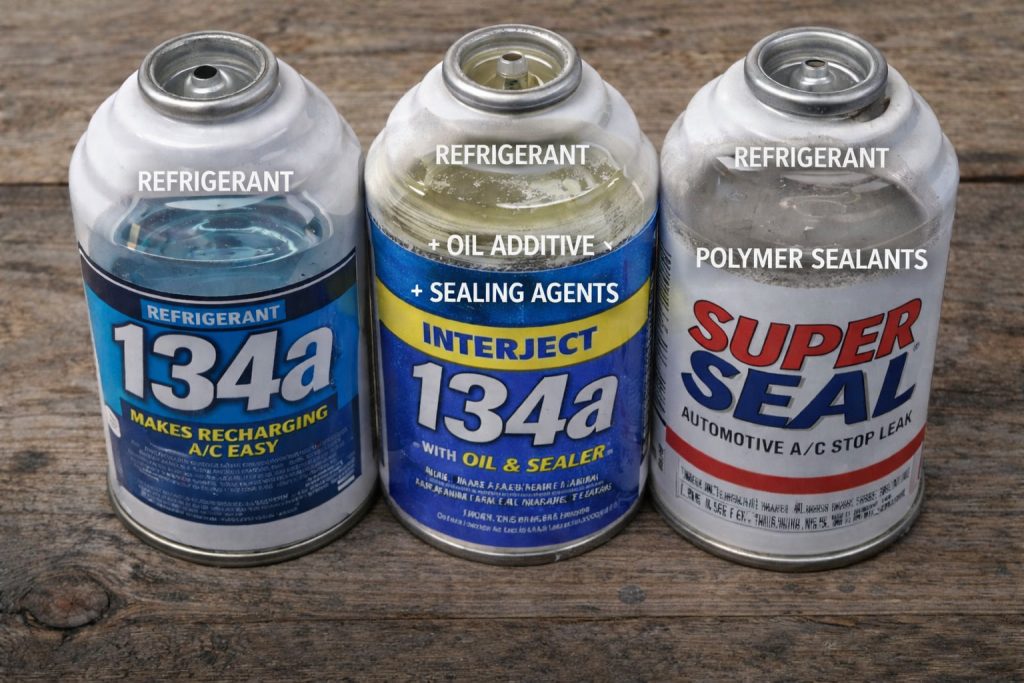
It Looks Like a Quick Fix — But the Ingredients Can Change Everything
When your A/C starts blowing warmer air, the fastest “solution” many drivers in the U.S. reach for is a recharge kit from a popular auto parts store or big-box retailer. The packaging makes it feel simple: connect, squeeze the trigger, watch a gauge, and enjoy cold air again.
And sometimes, it does feel colder right away.
- The catch is that many of these products don't contain "just refrigerant." Some include oil, leak-detection dye, sealants, or blended contents that can create short-term improvement while setting you up for long-term problems—especially if your car A/C isn't blowing cold because of a leak or an underlying mechanical issue.
Let’s break it down in plain terms: what can be inside these cans, why it can backfire, and what “doing it once and doing it right” actually looks like.
What Can Be Inside: The Most Common Real-World Scenarios
Different cans are marketed differently. The big label might say “recharge,” but the details are often in smaller print.
The right questions are:
- What's actually inside?
- What else is added besides refrigerant?
- How does that affect your system and future service?
Here are the most common categories.
Option #1: "Just Refrigerant" (The Least Risky Retail Version)
Some products are essentially A/C recharge cans that contain only refrigerant. This is the cleanest scenario you’ll find in a retail format.
But even then, there are two major issues:
- You still can’t charge accurately without charging by weight.
- Gauge pressure isn’t the same as the exact amount in the system.
- So even with "pure refrigerant," you can still end up undercharged (weak cooling) or overcharged (added stress), and you still won't fix the root cause if there's a leak.
Option #2: Refrigerant + Oil ("With Oil" / "Conditioner")
A very common variation includes refrigerant plus added oil. It’s marketed like a benefit: “helps lubricate the compressor.”
- Here's the key point: automotive A/C systems are designed for a specific total oil amount. Oil isn't a vitamin you can keep adding "just in case." If you repeatedly use cans that include oil, you can create too much A/C oil in the system over time.
That’s where things get expensive.
Critical Nuance: Many Cans Add Oil and UV Dye Together — and It Accumulates
Some products include UV dye (leak detection) suspended in an oil base. That means each time someone uses a can, they may be performing adding oil during an A/C recharge without realizing it.
If a driver tops off once, then again a month later, then again next season, the system can slowly accumulate extra oil. Over time, that can cause real problems, including:
Lower cooling efficiency: Too much oil can reduce heat transfer and make the system cool weaker even after "recharging."
Oil pooling in components: Excess oil can hang up in heat exchangers and lines, making performance inconsistent (cold sometimes, weak other times).
Flow and metering issues: A/C systems rely on proper refrigerant flow and metering. Excess oil can contribute to unstable behavior that feels like "it never cools the same way twice."
Expensive component-level consequences: In some cases, restoring proper operation can involve real labor and parts (for example, a stuck or restricted expansion valve, or a saturated accumulator/receiver-drier). This is where a "cheap can" can turn into a very expensive repair.
- This isn't meant to scare anyone—just to make the hidden math visible: if each top-off adds even a small oil dose, it adds up.
Option #3: Refrigerant + UV Dye (Leak "Finder")
UV dye sounds smart: “I’ll add this, then find the leak.”
The problem is that dye doesn’t magically diagnose the system by itself. If the system is already low, you still need a real process to confirm leaks and verify the system is sealed. Dye can be part of a professional strategy, but it’s not a replacement for proper testing.
Option #4: Refrigerant + Sealant ("Stop Leak" / "Leak Sealer")
This category is the most risky.
Sealants are marketed as a way to “seal micro-leaks” without repair. In reality, you don’t control where it reacts, how it behaves, or how it affects future service. It can complicate proper diagnostics and make corrective repairs more expensive.
- If you want reliable cooling, sealant is usually the opposite of "clean and predictable."
Option #5: Blends / "Substitutes" / Unknown Mixes
If your car A/C isn’t blowing cold, that doesn’t mean disaster. In many cases, the fix is straightforward—when it’s done properly.
A professional car A/C recharge isn’t guessing. It’s a controlled process designed to restore correct operation without adding risk.
What ACRechargePro provides
- Even worse, you can end up with mixed refrigerant in the system if someone previously added the wrong type "because it was available." Once a system is mixed or unknown, proper service becomes harder and riskier—especially for any equipment that recovers and stores refrigerant.
This is one of the reasons professional service often includes refrigerant identification before recovery in questionable cases.
Why "It Got Colder" Doesn't Mean "The System Is Healthy"
A short-term improvement can hide the real story:
1. The leak is still there
If refrigerant is low, it usually went somewhere. A top-off without fixing the leak becomes a loop.
2. You're still guessing the amount
Without charging by weight, you're not controlling the charge. This is a major source of the consequences of improper recharge.
3. The additives can create long-term headaches
Oil, dye, sealants, and blends can make future diagnostics and proper service more difficult and more expensive.
- If your car A/C isn't blowing cold, the goal isn't "make it feel colder today." The goal is stable, repeatable, correct operation.
What To Do Instead (If You Want It Done Once — Correctly)
A solid, professional logic looks like this:
- Don't guess with a top-off.
- Confirm whether the system is sealed.
- Recover, evacuate, and recharge by weight to the vehicle spec.
- If there's doubt about tightness, verify properly (and escalate to pressure verification when needed).
- The difference is simple: control and confirmation instead of guesswork.
How ACRechargePro Handles It the Right Way
ACRechargePro focuses on a controlled process so you know what’s happening and why:
Diagnostic-first approach
Recovery and accurate recharge by weight (not by gauge guess)
Leak verification and nitrogen pressure testing when appropriate
EPA Section 609–certified service
Mobile service at your location (driveway service)
Typical service time: 60–90 minutes
- No guessing. No "maybe." Clear results.
Conclusion
Store-bought A/C recharge cans are popular because they promise a fast fix. But many contain more than refrigerant—oil, dye, sealants, or blends—and those extras can quietly create bigger problems over time.
- If you want reliability, the safest route is: confirm the cause, verify sealing, and recharge by weight to the correct specification—without stacking unknown additives into the system.