
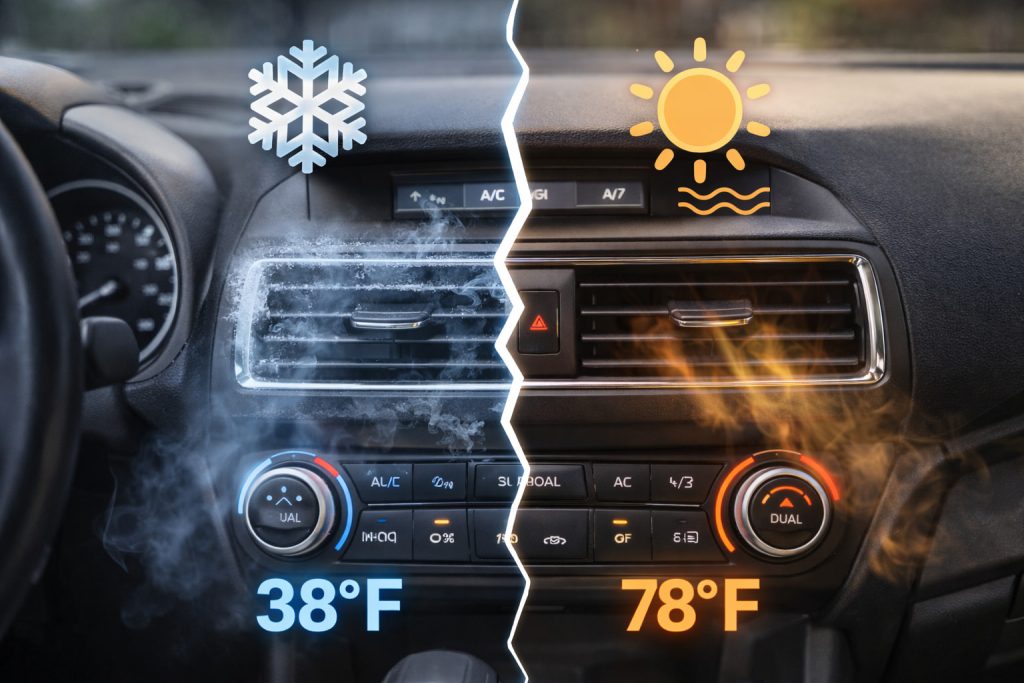
The Most Frustrating A/C Problem: It Works… Until It Doesn't
Few car problems are as annoying as inconsistent A/C. One day it feels fine. The next day it’s weak. Sometimes it blows cold while you’re driving, then turns warm at a stoplight. Or it’s cold at idle and gets worse on the highway.
This usually leads to the same assumption: “It must be low on refrigerant—I’ll just add a little.”
But intermittent cooling is often a sign that the system is operating on the edge of correct conditions—or that the problem isn’t refrigerant amount at all.
Why a "Quick Recharge" Often Doesn't Fix Intermittent Cooling
A/C performance depends on several variables at once:
- correct refrigerant charge by weight
- good airflow across the condenser
- dry, clean internal conditions (no air/moisture problems)
- components operating normally under load
A DIY top-off typically changes only one thing (maybe): the amount of refrigerant—and even that part is usually guessed by pressure.
So the result can look like this:
- you add refrigerant,
- it improves temporarily,
- then the symptoms return,
- or the behavior becomes even more unpredictable.
That’s why people often say: recharge didn’t fix A/C.
Scenario #1: Cold While Driving, Warm at Idle
When the A/C is colder while driving and warmer at idle, the system is benefiting from natural airflow at speed. That points to an airflow or heat-removal problem.
Common contributors include:
- weak condenser airflow when stationary
- the system struggling to reject heat at idle conditions
- a charge level that’s close but not correct, causing performance to swing with conditions
The key takeaway is simple: A/C blows warm at idle is not automatically “just add more refrigerant.” It often means the system is sensitive to airflow and operating conditions.
A proper service approach focuses on restoring control: correct charge by weight, and confirming the system is operating within healthy conditions.
Scenario #2: Cold at Idle, Warmer While Driving
This one surprises people. If it’s colder at idle but worsens at speed, the issue can be different—often related to the system’s behavior under changing load.
Sometimes it’s a system that isn’t correctly charged (under or over), where conditions change enough at speed to push it out of its “comfortable zone.”
Sometimes it’s a sign that a small leak or internal issue is creating inconsistent operation.
This is why A/C cold while driving not at stop (or the reverse) is a symptom—not a diagnosis. The system needs measured service, not guesses.
Scenario #3: It's Cold, Then Suddenly Turns Warm
If your A/C starts cold and then fades to warm during the same drive, that’s usually a sign the system is drifting away from stable operating conditions.
The most common reasons include:
- charge amount not being correct by weight (too low or too high)
- a leak that’s still present (cooling fades as charge decreases over time)
- air/moisture issues that reduce stability and consistency
- component-level issues that are outside the “refrigerant amount” category
From the driver’s seat, it all feels the same: “It was cold, then it wasn’t.”
That’s why the correct response is not another can. It’s controlled verification.
This pattern is often described online as: car A/C cold then warm.
The "Low Refrigerant" Reality Check
Yes—low refrigerant can cause inconsistent cooling.
But here’s the important part:
If refrigerant is low, it’s usually because it leaked. Refrigerant doesn’t get “used up” in a healthy closed system
So if symptoms come and go over days or weeks, and the system gradually gets weaker, that’s a strong clue that the system isn’t tight.
And that means topping off becomes a cycle:
- add refrigerant,
- it cools for a bit,
- it leaks out,
- symptoms return,
- repeat.
That cycle is one of the fastest ways to end up with bigger problems and frustration.
Why Pressure Readings Can Mislead Intermittent Problems
Inconsistent cooling is exactly where pressure-based guessing causes the most confusion.
Pressure changes with temperature, airflow, and operating conditions. So the same system can show different readings at different moments—without telling you whether the charge amount is correct.
That’s why color-zone gauges and quick pressure checks can give a false sense of certainty. Intermittent problems require a controlled process:
- remove air/moisture with vacuum evacuation
- confirm leak integrity when needed
- recharge by weight
Otherwise you’re adjusting the system while blindfolded.
The Correct Way to Diagnose Intermittent A/C
A professional approach keeps it simple and measurable:
- Confirm the symptom pattern (idle vs driving, cold then warm, etc.)
- Recover what’s in the system (if needed)
- Perform vacuum evacuation to remove air and moisture
- If vacuum doesn’t hold, perform leak verification (commonly nitrogen pressure testing)
- Recharge by weight to manufacturer specification
- Confirm stable performance
This prevents the two biggest failures:
- charging a system that isn’t sealed
- charging by guesswork instead of by weight
How ACRechargePro Solves Inconsistent A/C the Right Way
ACRechargePro uses a controlled process designed to stop the repeat-visit cycle:
- Certified refrigerants only
- EPA Section 609–licensed service
- Recovery + vacuum evacuation (remove air/moisture)
- Recharge by weight to specification
- Leak verification and nitrogen pressure testing when appropriate
- Mobile service: we come to your driveway
- Typical service time: 60–90 minutes
- No guessing. No “top-off experiments.” Controlled results.
We’re not here to criticize DIY. But intermittent A/C problems are exactly where DIY guesswork usually costs more than it saves.
Conclusion
If your A/C is cold sometimes and warm other times, the odds are high that the issue is not solved by a simple top-off. Intermittent cooling usually means the system is operating on the edge—charge amount, airflow, sealing integrity, or internal conditions.
That’s why car A/C inconsistent cooling often leads to the same outcome when people guess: recharge didn’t fix A/C, or worse.
If you want a stable result, the correct approach is vacuum evacuation, leak verification when needed, and a recharge by weight to spec.
Schedule professional A/C service now:
Related Articles
Frequently Asked Questions
Why is my car A/C cold sometimes and warm other times?
Because A/C performance depends on charge amount, airflow, and system stability. If any of these are borderline or inconsistent, cooling can swing with conditions.
Does intermittent A/C always mean low refrigerant?
Not always. Low refrigerant can cause inconsistency, but airflow issues, moisture/air problems, or underlying component issues can also create the same symptom.
Why does my A/C blow warm at idle but cool while driving?
Often the system relies on natural airflow at speed. If stationary airflow is weaker, cooling can drop at idle. A controlled recharge and verification process helps confirm what's actually happening.
Why does a recharge sometimes help briefly, then the problem returns?
If there's a leak, the refrigerant leaves again. If charging was not done by weight or the system wasn't properly evacuated, the result can be unstable.
What should be done before recharging an A/C system?
Vacuum evacuation to remove air and moisture, and leak verification when needed—especially if the system was empty/low or vacuum doesn't hold.
How long does professional A/C service take?
Typically 60–90 minutes, depending on system condition and whether leak verification is needed.