
It Sounds Perfect: Press a Button and You're Done
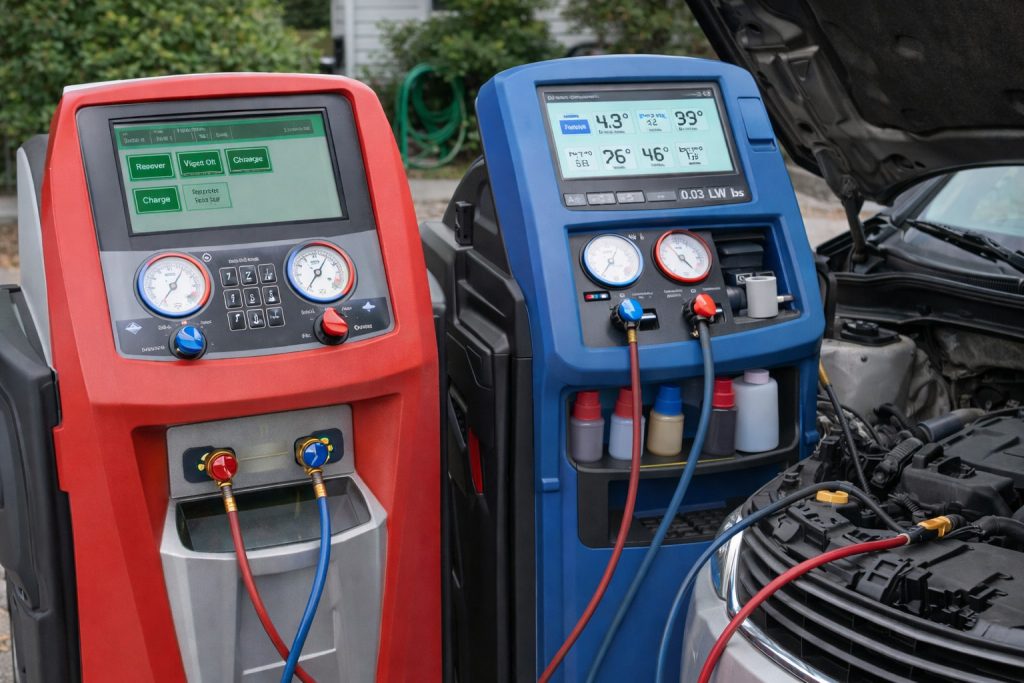
An automatic AC recharge station looks like the best-case scenario: connect the hoses, hit “Start,” and the machine runs the full cycle—recover, vacuum, “test,” and recharge by weight. To most drivers, that feels modern, precise, and safer than anything “manual.”
- And yes—automatic stations have real advantages. They can make service faster and more consistent.
But here’s the nuance: automation doesn’t automatically make service “smarter.” It makes it more standardized. Standardization is great for clean, typical cases. When the system has any unknowns—leaks, questionable service history, or contaminated refrigerant—an automatic approach can become a hidden risk.
- Let's break it down honestly: where automatic stations shine, and where the biggest drawbacks live.
Pro #1: Speed and Repeatability
The biggest advantage is speed. An automatic recharge machine can complete a typical recover–vacuum–recharge cycle faster than many manual workflows—especially in a high-volume shop.
What that gives you:
Undercharge
Correct charge
Overcharge
In short: for a healthy system with no surprises, an automatic car AC recharge can be efficient and convenient.
Pro #2: Great for "Healthy" Systems Without Surprises
If the A/C system is in good condition, has the correct refrigerant, and the goal is routine service—not troubleshooting—automatic service can be a reasonable fit.
- But once any red flags show up, the strengths start to fade quickly:
- DIY cans in the past,
- unclear leak history,
- unstable cooling,
- or signs of a serious failure.
That’s where the “push-button confidence” can become misleading.
Con #1: A Vacuum Check Isn't the Same as "No Leaks"
One of the most common traps is treating a machine’s vacuum test as proof that the system has no leaks.
- Vacuum and pressure are not the same operating reality. A/C systems run under pressure during normal operation, and some leaks can behave differently under vacuum versus pressure.
So a system can “hold vacuum” yet still have a leak that shows up later under real operating conditions.
That’s why, when there’s any doubt, a nitrogen pressure test is often the stronger confirmation. It checks the system under pressure—closer to real-world stress—rather than relying only on vacuum behavior.
Con #2: The Machine Follows a Script—It Doesn't "See the Story"
An automatic machine runs an algorithm. That’s helpful until the situation stops being typical.
The downsides are practical:
- the machine doesn’t explain why the system behaves a certain way;
- it may keep running the cycle even when a human would pause and reassess;
- it can create a false sense of certainty simply because the process looks “automated.”
- A controlled manual approach has a different strength: you can actually observe the process, interpret what you're seeing, and change strategy in real time—especially when the system shows signs that it needs pressure testing, deeper verification, or a stop before recharging.
Con #3: The Shared-System Risk—Cross-Contamination Can Happen
Here’s one of the biggest issues people rarely talk about.
Many automatic service setups behave like a shared workflow: refrigerant is recovered, filtered/dried, and stored within the machine’s internal path (or cycled through a common system). That can be efficient—but it also introduces the risk of cross-contamination of refrigerant if a “bad” vehicle enters the process.
- To be fair: not every station is identical, and many have filters. But filters are not magic. Their effectiveness depends on the type of contamination and whether the station is properly maintained and used with the right safeguards.
The core point is simple:
- In a shared workflow, one contaminated system can create problems beyond that one car.
Con #4: "Unknown Refrigerant" Can Ruin the Process (and the Equipment)
This is the modern reality: you often don’t know what’s in the system.
Undercharge
A vehicle may have been serviced with DIY cans that aren’t a clean, known refrigerant charge. Some products are blends or additives that the owner assumes are equivalent. In practice, these can-based refrigerant substitutes create uncertainty: you may not be dealing with a clean, known composition.
Correct charge
A vehicle may have been serviced with DIY cans that aren’t a clean, known refrigerant charge. Some products are blends or additives that the owner assumes are equivalent. In practice, these can-based refrigerant substitutes create uncertainty: you may not be dealing with a clean, known composition.
- This is where a refrigerant identifier matters. It helps confirm what's actually inside before the service process begins—especially before anything gets recovered into shared equipment.
And this is exactly why an automatic AC recharge station can become a “silent risk” if identification is skipped: one questionable car can compromise the workflow for the next vehicles.
The Good News: You Can Do It the Right Way—with Full Process Control
Speed is nice. But with expensive A/C components, safety and control matter more than speed.
When there’s any uncertainty—leaks, mixed refrigerant history, or unstable performance—the safer approach is a controlled, transparent procedure: you see what’s happening, you can verify properly, and you can choose the correct next step.
That’s where a professional car AC recharge stands apart from a “scripted cycle”:
System diagnostics and testing
Recovery, weighing, and precise recharge by weight
Nitrogen pressure test when needed (stronger confirmation than vacuum alone)
Mobile service at your location (driveway service)
EPA Section 609–certified technicians
Typical service time: 60–90 minutes
Clear visibility into what was done—and why
- The point isn't "automatic stations are bad." The point is: when there are unknowns, you want a process where the technician can verify, adapt, and protect your system.
Conclusion
The pros and cons of an automatic station come down to a simple formula:
Pros
- Fast
- Consistent
- Convenient for straightforward cases
Cons
- Vacuum test alone doesn't guarantee leak-free performance
- The process can be less transparent
- Shared workflows introduce contamination risk—especially when the system contains unknown refrigerant
- If you want to do it once and do it right—especially when performance is unstable—choose a method that emphasizes control, accurate charging by weight, and pressure verification when necessary.
Schedule professional A/C service now:
Related Articles
Frequently Asked Questions
Is an automatic station always better than a manual approach?
Not always. It’s great for routine, healthy systems. For leaks, unknown refrigerant history, or contamination risk, controlled service and verification matter more than speed.
Why can a vacuum check pass even if a leak exists?
Because vacuum test conditions are different from real operating pressure. Some leaks behave differently under pressure than under vacuum.
Why use nitrogen at all?
A nitrogen pressure test checks the system under pressure and can provide stronger confirmation in questionable cases than vacuum-only verification.
What is cross-contamination, and why should I care?
Cross-contamination of refrigerant is when contamination from one vehicle affects equipment and potentially later vehicles in a shared workflow.
What does a refrigerant identifier do?
A refrigerant identifier checks what refrigerant (or blend) is actually in the system before service, reducing the risk of contaminating equipment and future vehicles.
Can DIY can products create real problems?
Yes. Can-based refrigerant substitutes and mixed refrigerants can contaminate the charge and create service complications.
Do you offer mobile service?
Yes. We come to your location and perform service on your driveway.