
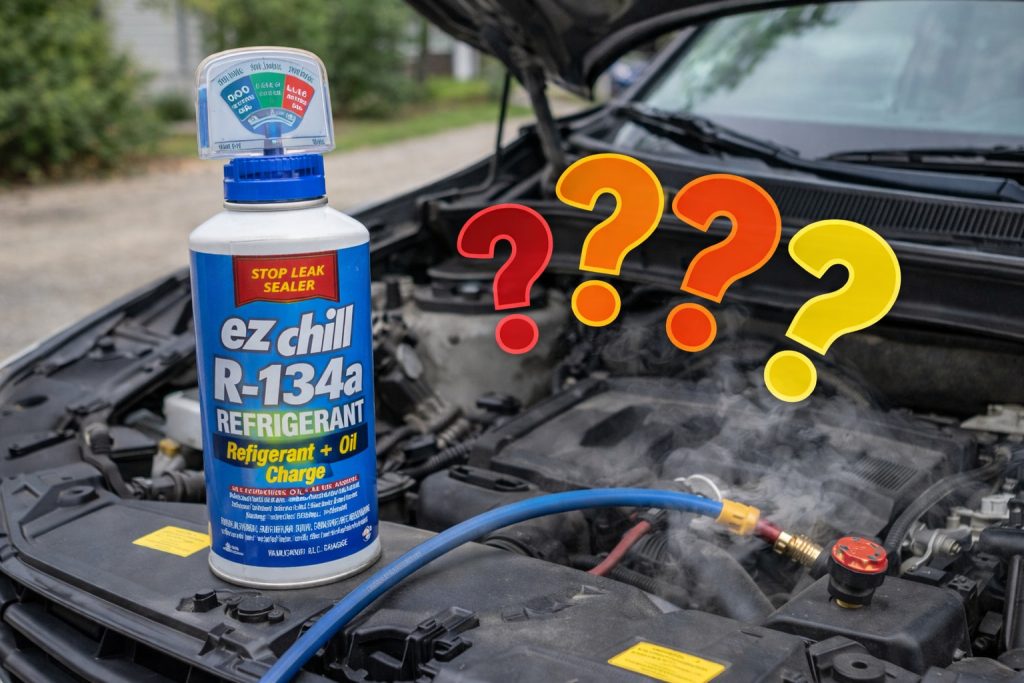
It Sounds Logical — But It's Misleading
A lot of drivers run into the same situation: a month ago the A/C felt strong, and now the air is a bit warmer. The thought is totally understandable: “It probably just needs a little refrigerant. I’ll top it off.”
That logic works for things like windshield washer fluid or, in some cases, engine oil. But automotive A/C is different.
Myth: “If it’s a little warmer, I just need to add a little refrigerant.”
Reality: The A/C system is sealed. If everything is healthy, refrigerant doesn’t “wear out” or “disappear over time.” It doesn’t burn off. It circulates inside a closed loop.
So if the refrigerant level is lower than it should be, that’s usually a sign of a real issue—most commonly a leak—that needs to be found and fixed. A car A/C top-off can feel like a solution, but in many cases it’s just a temporary patch that ends up costing more later.
- The good news: this is fixable. You just want to avoid the "add a little and hope" approach.
Problem #1 — You Don't Know How Much Is Left
The biggest issue is simple: you don’t know how much refrigerant is actually in the system right now. You can’t judge it by “how it feels,” and you can’t measure it accurately by guessing.
- Pressure is NOT the same as amount
A common mistake is relying on pressure readings—especially with basic gauges or “green zone” indicators.
But pressure does not tell you the exact amount of refrigerant in the system. Pressure depends on multiple factors: outdoor temperature, engine RPM, airflow across the condenser, and operating conditions. You can see “acceptable” pressure while the charge amount is still wrong.
- A simple analogy: oven temperature ≠ food weight. A thermometer can show the right temperature, but that doesn't mean you used the correct amount of ingredients. Same with A/C: a pressure number can look fine even when the charge amount is not.
Without recovery and weighing, you can’t dose it correctly
If you want to know how much refrigerant your A/C needs, you need the correct process: recover what’s in the system, evacuate properly, and then recharge by weight according to the factory specification.
When you try a “little bit” top-off, you end up in one of two scenarios:
Undercharge — cooling stays weak or inconsistent, performance suffers.
Overcharge — more dangerous: added stress, unstable operation, and a higher risk of compressor damage.
This is the first big reason why you shouldn’t add refrigerant “just a little.” Without the proper procedure, you’re not controlling the dose—you’re guessing.
Problem #2 — The Leak Cause Doesn't Go Away
Let’s say you add refrigerant and the A/C feels colder for a while. That can create the impression that the problem is solved.
But if refrigerant was low, it typically went somewhere. In other words: there’s usually an underlying cause.
- Even if you add it, it can leak out again
Recharging an A/C with a leak is like adding water to a bucket with a pinhole. You might see an immediate improvement, but the root cause is still there—so the symptom returns.
The practical downsides are straightforward:
- It’s a temporary “patch,” not a repair.
- Refrigerant isn’t free—you’ll pay again, either in money, time, or frustration.
- The longer a leak is ignored, the more likely the issue grows, and the harder it can be to diagnose later.
Until the leak is found and corrected, topping off is usually an expensive loop: add → cool briefly → lose charge again → repeat.
Problem #3 — You Can Make It Worse
A lot of people think: “What’s the harm in adding a little?” The harm isn’t theoretical—it’s how A/C systems behave when the charge and conditions aren’t controlled.
Overcharge → extra stress → compressor risk
The compressor is one of the most expensive components in the A/C system. It’s designed to operate within specific conditions. When the system is overcharged, it may run outside its optimal range and experience unnecessary stress.
Air and moisture contamination → long-term problems
Another risk is introducing air and moisture, especially when service is done without proper evacuation. Moisture inside the A/C system is not a minor detail—it can contribute to internal corrosion and shorten component life over time.
- That's when a small annoyance becomes a bigger bill.
These are real consequences of an improper recharge: what starts as “it’s not as cold” can turn into “now it needs a major repair.”
Problem #4 — It Doesn't Align With EPA Standards
In the U.S., automotive A/C service is regulated, and the proper approach is performed by certified technicians under EPA Section 609 practices.
What this means for you as a driver is simple:
Correct procedure matters.
Safety matters.
"Guess and add" is not the standard.
- A system where your car A/C isn't blowing cold shouldn't be treated like a tank you can casually "top off." It should be tested, prepared correctly, and charged by weight—based on what the system actually needs and whether it's holding pressure.
The Good News: You Can Do It the Right Way
If your car A/C isn’t blowing cold, that doesn’t mean disaster. In many cases, the fix is straightforward—when it’s done properly.
A professional car A/C recharge isn’t guessing. It’s a controlled process designed to restore correct operation without adding risk.
What ACRechargePro provides
Professional system diagnostics and testing
Recovery, weighing, and a precise recharge by weight
Leak verification using dry nitrogen testing
Mobile service at your location (right on your driveway)
EPA 609–certified technicians
Typical service time: 60–90 minutes
We follow the correct procedure—not "by feel" or "by guess"
- In other words, you get what a car A/C top-off can't deliver: correct quantity control, clarity about system health, and a result built for reliable performance.
Conclusion
A “by-guess” top-off is a temporary and risky method:
- you don't know the true refrigerant amount,
- you don't fix the underlying cause (often a leak),
- you can overcharge and stress the compressor,
- you can contaminate the system with air and moisture.
The correct path:
Identify the cause, recover and evacuate properly, then recharge exactly by weight. That’s more reliable—and usually cheaper—than paying for the consequences of an improper recharge later, especially if a compressor gets damaged.
Schedule professional A/C service now:
Related Articles
Frequently Asked Questions
Can I just add refrigerant to my car A/C?
Not safely. First you need to confirm the system is sealed and determine the correct charge amount by weight.
Why is my A/C blowing weak or not as cold?
There are many causes—refrigerant loss from a leak, airflow issues, or compressor-related problems. The correct diagnosis matters.
Can I top off my A/C without diagnostics?
It’s not recommended. You can easily overcharge, undercharge, or mask a leak and create a bigger problem.
How much does a proper A/C recharge cost?
It depends on the vehicle and condition. A correct service typically takes 60–90 minutes and includes diagnostic steps.
What if it’s only a little less cold than before?
That’s still a symptom. “A little” often becomes “not working” if the underlying cause isn’t addressed.
What happens if I overcharge the system?
Higher stress and a higher risk of compressor damage—one of the most common consequences of an improper recharge.
Do you provide mobile service?
Yes. Service is performed on the customer’s driveway.