
1) Hook Intro
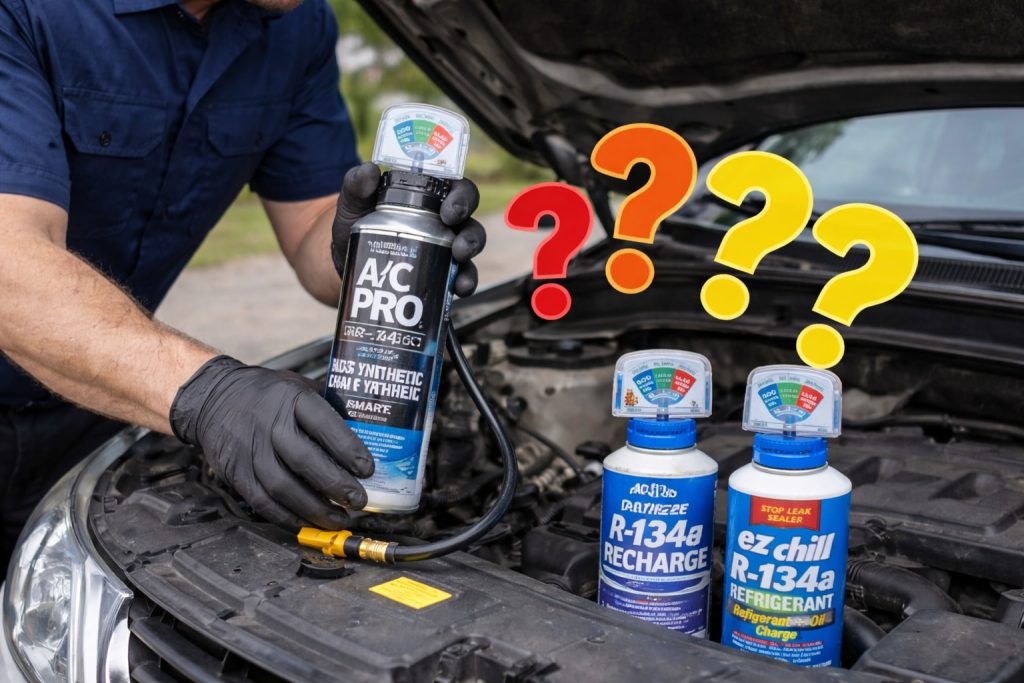
Disposable A/C recharge cans are popular for one simple reason: they look cheap, fast, and “DIY-friendly.” You grab one at a big-box store, hook it up, squeeze the trigger, and expect cold air in minutes. The packaging promises “instant cooling” and makes it feel like a quick top-off is all your car needs.
- But here's the catch: an automotive A/C system is not a "just add more and drive" setup. It's a closed system where cleanliness, tight sealing, and an exact charge by weight matter.
If you guess wrong, the outcome can be expensive—from “it got worse” to real compressor damage.
- A simple analogy: oven temperature ≠ food weight. A thermometer can say "normal," but that doesn't mean you used the right amount of ingredients. Same idea with A/C: one pressure reading doesn't prove the system is correctly charged.
2) Danger #1: The Can Gauge Is Misleading
The biggest “selling point” is the built-in gauge with green and red zones. It looks foolproof: needle in green = good, in red = bad. In reality, it’s oversimplified.
Why it misleads people:
Green/red zones are not real diagnostics. They’re generic and don’t match your specific vehicle conditions.
Pressure does not tell you how much refrigerant is in the system. Pressure changes with ambient temperature, operating conditions, and airflow.
One pressure number without context is not informative. You can see “normal” pressure even when something is wrong.
- Simple example: you can't tell how much to add just by watching a needle. It's like looking at a "somewhere in the middle" fuel gauge and trying to guess exact gallons.
That’s why a DIY top-off using a can gauge is closer to guessing than controlling the charge.
3) Danger #2: You Don't Know How Much Refrigerant Is In Your System
Every vehicle has a specific refrigerant charge listed by the manufacturer—usually in ounces (oz) or grams. It’s not “about this much.” It’s an exact amount designed for proper performance.
Key points:
- Each car has its own spec.
- Many systems fall around 14–26 oz, but it varies by model.
- Quick conversion: 1 lb = 16 oz ≈ 454 g.
So the big question is: How do you know how much is left?
Realistically, you don’t—if you’re just topping off without proper equipment.
Because:
- You don’t know what was in the system before you connected the can.
- You don’t know how much leaked out over time.
- You can’t accurately measure what you added without weighing and controlling the process.
- Proper car A/C recharge is done by weight, not by "feel" or a gauge color. Without that, the chance of overcharging is high—especially when the A/C cools "sometimes" and you're tempted to add more.
4) Danger #3: Overcharging Can Kill the Compressor
The compressor is one of the most expensive parts in the A/C system—and it doesn’t tolerate extremes.
What overcharging can cause:
- Excess refrigerant can increase system stress and push operation out of its normal range.
- The system may behave unpredictably and run inefficiently.
- The compressor can be put under unnecessary load, increasing the risk of damage.
Undercharge
Poor performance
Correct charge
Optimal cooling
Overcharge
Compressor stress
- Here's the calm truth: compressors don't like undercharge OR overcharge. Both can lead to poor performance and long-term problems. And both often start the same way: "It's not as cold—let me add a little more."
If your car A/C stops working after recharge, this is one of the common paths: a top-off done without accurate charge control.
5) Danger #4: Air and Moisture Get Into the System
A/C systems need to stay clean and dry. DIY can kits don’t give you real control over what enters the system.
What can happen:
- Air can remain inside the hose and fittings.
- That air can be pushed into your A/C system.
- With air comes moisture.
- Moisture in an A/C system can lead to corrosion and long-term reliability issues. It can also make cooling inconsistent and complicate future service.
That’s why the correct procedure includes vacuum evacuation—to remove air and moisture before charging. It’s not an “extra step.” It’s a core part of doing it right.
6) Danger #5: Unknown or Incorrect Refrigerant Mix
Another hidden risk is not knowing what’s really in the can—and whether it truly matches your system.
The problem:
- Some cans may not contain the exact refrigerant your vehicle requires.
- Some products are blends/substitutes that behave differently.
- Some “propane-like” substitutes are not typically approved by automakers.
- If the contents or mix are unclear, charging by weight becomes even more uncertain.
- No panic needed here: the issue isn't that every can is "bad." The issue is that with DIY cans, you often lose control over the two things that matter most: exact charge amount and exact composition. That can affect seals, performance, and the cost of future repairs.
7) The Good News: You Can Do It the Right Way
The good news is you don’t have to gamble. Doing it correctly isn’t magic—it’s a straightforward, professional procedure: prepare the system, verify conditions, and charge by weight with proper steps.
How ACRechargePro does it correctly:
Certified refrigerants only
Per EPA Section 609 standards (licensed)
Vacuum recovery/evacuation, refrigerant weighed in, and system checked with nitrogen testing
Mobile service: we come to your driveway—no shop visit needed
Typical service time: 60–90 minutes
- No guessing. No risk. Just results.
We’re not here to attack DIY. Wanting to save money makes sense. But if your goal is “do it once and do it right,” professional charging is usually cheaper than paying for the consequences of a bad recharge later.
😍 Conclusion
A one-time can might make the air feel cooler for a moment—but it often creates a false sense of “fixed,” because you’re not controlling the key factors: charge by weight, dryness, and correct refrigerant.
- And the price of a mistake can be high. Improper recharge consequences include compressor stress, unstable cooling, and cases where the car A/C stops working after recharge—turning "cheap and quick" into "expensive and slow."
If you want to do it once—and do it correctly—you need vacuum evacuation and a recharge by weight, not a guess based on a green zone.